AI & Semantic Search
Search Is Changing. Is the Business Ready for What's Next?
AI-powered search engines don’t just match keywords — they understand meaning, context, and relationships. Google’s AI Overviews, ChatGPT, Perplexity, and other AI search tools are reshaping how customers find businesses. This service makes sure the website is structured to be visible, cited, and recommended in this new landscape.
AI Search Readiness
Future-Proof
Schema
Complete
Full structured data
Entities
Defined
Machine-readable identity
The Shift Happening Now
Search Isn't Just About Keywords Anymore
For two decades, SEO was mostly about keywords — find the right ones, put them in the right places, build some links, and rank. That still matters, but the game is expanding dramatically.
Google now uses AI Overviews to generate summarized answers directly in search results. Tools like ChatGPT, Perplexity, and Gemini are becoming how millions of people research products, services, and businesses. These AI systems don’t just scan for keyword matches — they understand entities, relationships between concepts, and the meaning behind content.
The businesses that show up in these AI-generated answers are the ones whose websites are clearly structured, semantically rich, and machine-readable. The ones that aren’t? They get skipped — cited by no one, summarized by nothing, and invisible in the fastest-growing discovery channel in the world.
This service bridges the gap between traditional SEO and the AI-driven future — making sure the website is optimized for both.
Traditional Search
Keyword matching in 10 blue links
User types a query, sees a list of results, clicks through to websites. Content wins by matching keywords and earning links.
AI-Powered Search
Semantic understanding in generated answers
AI reads, synthesizes, and summarizes content — generating direct answers and citing sources it trusts. Content wins by being well-structured, authoritative, and machine-readable.
Zero-Click & Featured Results
Answers displayed without a click
Featured snippets, AI Overviews, People Also Ask, and knowledge panels answer queries directly in the SERP. Being the cited source in these results is the new #1 ranking.
What's Included
Everything in an AI & Semantic Search Optimization Project
A comprehensive set of deliverables designed to make the website understandable to both traditional search engines and AI-powered systems.
Advanced Schema Markup
Comprehensive structured data implementation beyond basic schema — organization, services, FAQs, how-to, article, breadcrumb, local business, and custom schema types. Fully validated and designed to trigger rich results and feed AI systems with clear, structured information.
Entity Optimization
Establishing the business as a recognized entity — connecting the website to Google’s Knowledge Graph through consistent entity references, structured data, authoritative citations, and linked data across the web. The more clearly Google understands what the business is, the more likely it appears in AI-generated results.
Semantic Content Structuring
Restructuring existing content and planning new content around topics, entities, and relationships — not just keywords. Content organized to answer questions comprehensively, cover related subtopics, and demonstrate depth that AI systems interpret as expertise.
Answer-Optimized Content
Specific content sections and page elements optimized to be directly quoted or cited by AI search engines — concise definitions, clear explanations, structured Q&A blocks, and summary paragraphs designed for featured snippets and AI Overviews.
llms.txt & AI Crawlability
Implementation of emerging standards that help AI crawlers understand and access the site’s content — including llms.txt configuration, clean content hierarchy, and proper markup that makes content easy for large language models to parse and cite.
Topic Authority Architecture
Building a content architecture that signals deep topical expertise — pillar pages, cluster content, internal linking patterns, and semantic relationships that demonstrate the site covers a subject comprehensively, not superficially.
Featured Snippet Optimization
Identifying and optimizing for featured snippet opportunities — paragraph snippets, list snippets, table snippets, and definition boxes. Structuring content with the exact formatting patterns Google uses to populate position zero results.
AI Visibility Monitoring
Tracking how the business appears (or doesn’t appear) in AI-generated search results — monitoring citations in AI Overviews, checking visibility in ChatGPT and Perplexity responses, and adjusting strategy based on where the site is being referenced.
Knowledge Panel Optimization
For businesses that qualify, optimizing for and claiming a Google Knowledge Panel — establishing the business as a verified entity with structured data, authoritative sources, and consistent references across the web.
The Process
How AI & Semantic Search Optimization Works — Step by Step
A structured approach that layers AI search optimization on top of existing SEO — not replacing traditional best practices, but extending them into the next era of search.
1
AI Search Readiness Audit
The project starts with an assessment of how the website currently performs across AI-powered search — checking structured data coverage, entity recognition, content structure, and whether the site is being cited in AI Overviews, ChatGPT, or Perplexity results.
- Existing schema markup audit — what's implemented, what's missing, what's broken
- Entity recognition check — does Google understand the business as a distinct entity?
- AI Overview monitoring — is the site appearing in Google's AI-generated results?
- Content structure analysis — is content organized for machine comprehension?
- Competitor AI visibility comparison — who's getting cited and why
2
Structured Data & Entity Foundation
Building the technical layer that makes the website machine-readable — implementing comprehensive schema markup, establishing the business entity, and creating the structured data infrastructure AI systems rely on to understand and cite content.
- Full schema markup implementation — organization, services, FAQ, article, breadcrumb, how-to
- Entity establishment — Knowledge Graph signals, consistent entity references
- llms.txt configuration for AI crawler accessibility
- Linked data connections — linking the website to authoritative external references
- Schema validation across all pages using Google's testing tools
3
Semantic Content Optimization
Restructuring and enhancing content so it communicates meaning — not just keywords — to both traditional search engines and AI systems. This includes reworking existing pages and creating new content specifically designed to be cited in AI-generated answers.
- Content restructured with clear topic hierarchies and semantic relationships
- Answer-optimized sections added — concise definitions, structured Q&A, summary blocks
- Topic cluster architecture reinforced with entity-based internal linking
- Featured snippet formatting applied to high-opportunity pages
- Content depth analysis — ensuring comprehensive topic coverage
4
Monitor, Measure & Adapt
AI search is evolving rapidly. Ongoing monitoring tracks how the site appears across AI platforms, identifies new opportunities as features roll out, and adjusts the strategy as the landscape shifts.
- AI Overview citation tracking — monitoring which pages are cited and for which queries
- Featured snippet win/loss tracking
- ChatGPT and Perplexity visibility checks for key business queries
- Schema performance review — rich result impressions and click-through rates
- Quarterly strategy updates aligned with evolving AI search capabilities
Why This Approach Is Different
What Sets This AI Search Optimization Service Apart
Forward-Looking, Not Reactive
Most SEO services optimize for where search was last year. This service optimizes for where search is going — preparing the website for AI-generated results, zero-click answers, and semantic understanding before competitors catch up.
Built on Traditional SEO Fundamentals
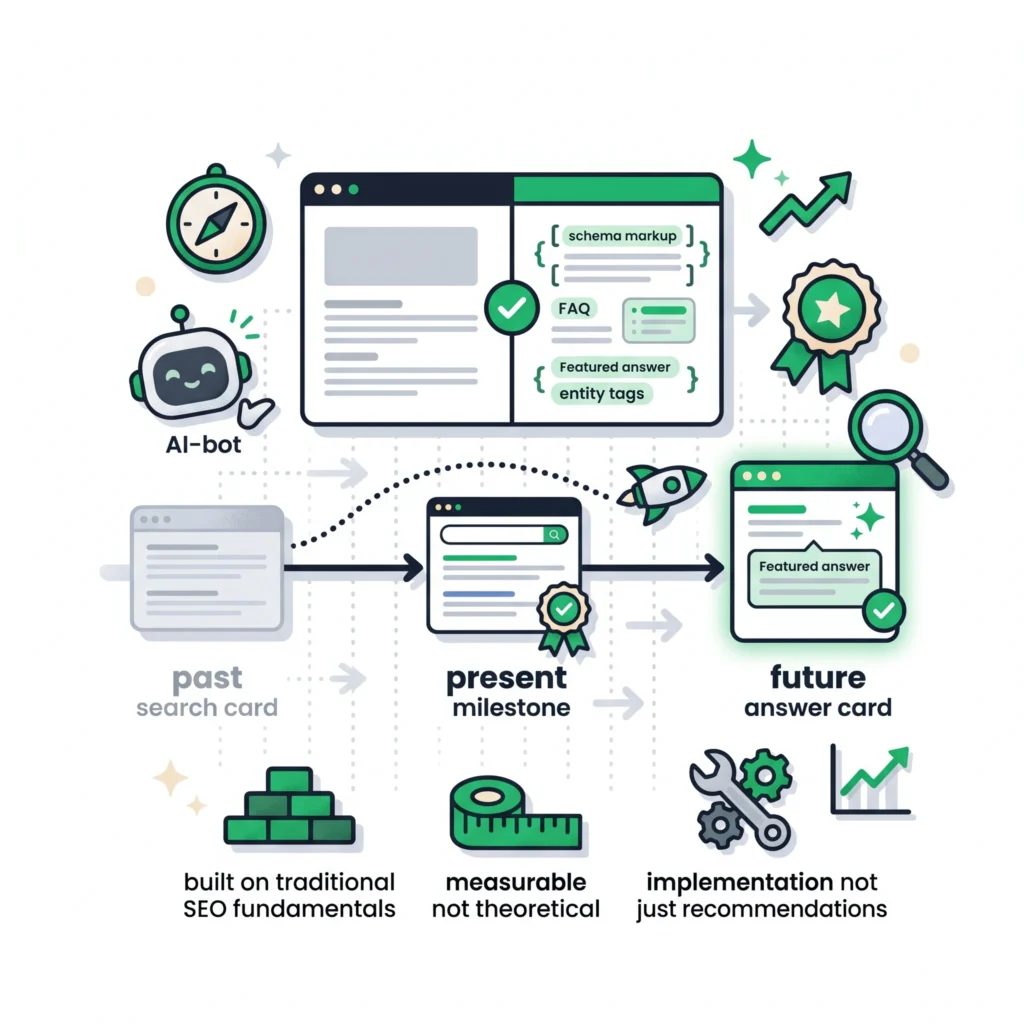
AI search optimization doesn’t replace traditional SEO — it builds on top of it. Technical health, on-page optimization, and quality content remain the foundation. Semantic and AI optimization amplifies what’s already working.
Measurable, Not Theoretical
This isn’t a vague “future-proofing” pitch. Every deliverable is tied to measurable outcomes — featured snippet wins, AI Overview citations, schema-triggered rich results, and entity recognition improvements. If it can’t be tracked, it’s not in the strategy.
Implementation, Not Just Recommendations
The service includes doing the work — not just delivering a report. Schema is implemented, content is restructured, entity signals are built, and monitoring is configured. The business gets results, not homework.
Frequently Asked
Questions About AI & Semantic Search Optimization
What is semantic search optimization?
Semantic search optimization is the practice of structuring website content so search engines understand its meaning — not just the keywords it contains. This includes organizing content around topics and entities, implementing structured data, and creating content that answers questions comprehensively. It helps both traditional search engines and AI systems interpret and rank the content more accurately.
Do I need this if I'm already doing regular SEO?
Traditional SEO is the foundation — but it’s no longer the complete picture. AI-powered search results are growing rapidly, and businesses that don’t optimize for them will lose visibility as more queries get answered by AI Overviews and conversational search tools. This service extends existing SEO efforts into the AI search layer, not replaces them.
How do AI search engines decide which content to cite?
AI search systems prioritize content that is clearly structured, comprehensive, authoritative, and easy to parse. They favor pages with strong structured data, clear topic organization, answer-formatted content, and signals of expertise and trustworthiness. Content buried in complex layouts, thin pages, or sites without structured data is far less likely to be cited.
What is an entity in the context of SEO?
An entity is a distinct, well-defined thing — a business, a person, a place, a concept. Google’s Knowledge Graph stores entities and their relationships. When Google recognizes a business as an entity, it can display Knowledge Panels, connect it to related topics, and surface it more accurately in both traditional and AI-generated results. Entity optimization makes the business a “known thing” to Google — not just a website with keywords.
What is llms.txt and do I need it?
llms.txt is an emerging standard — similar to robots.txt — that helps AI crawlers understand what content on a website is most important and how it should be processed. It’s still early in adoption, but implementing it now positions the site ahead of competitors as AI search tools increasingly look for these signals. It’s a small implementation with potentially significant long-term impact.
How do you track AI search visibility?
AI search visibility is tracked through a combination of methods — monitoring AI Overview appearances in Google Search Console, manually checking how the business is referenced in ChatGPT and Perplexity for key queries, tracking featured snippet wins, and measuring schema-triggered rich result impressions. The monitoring tools and methods are evolving alongside the platforms themselves.